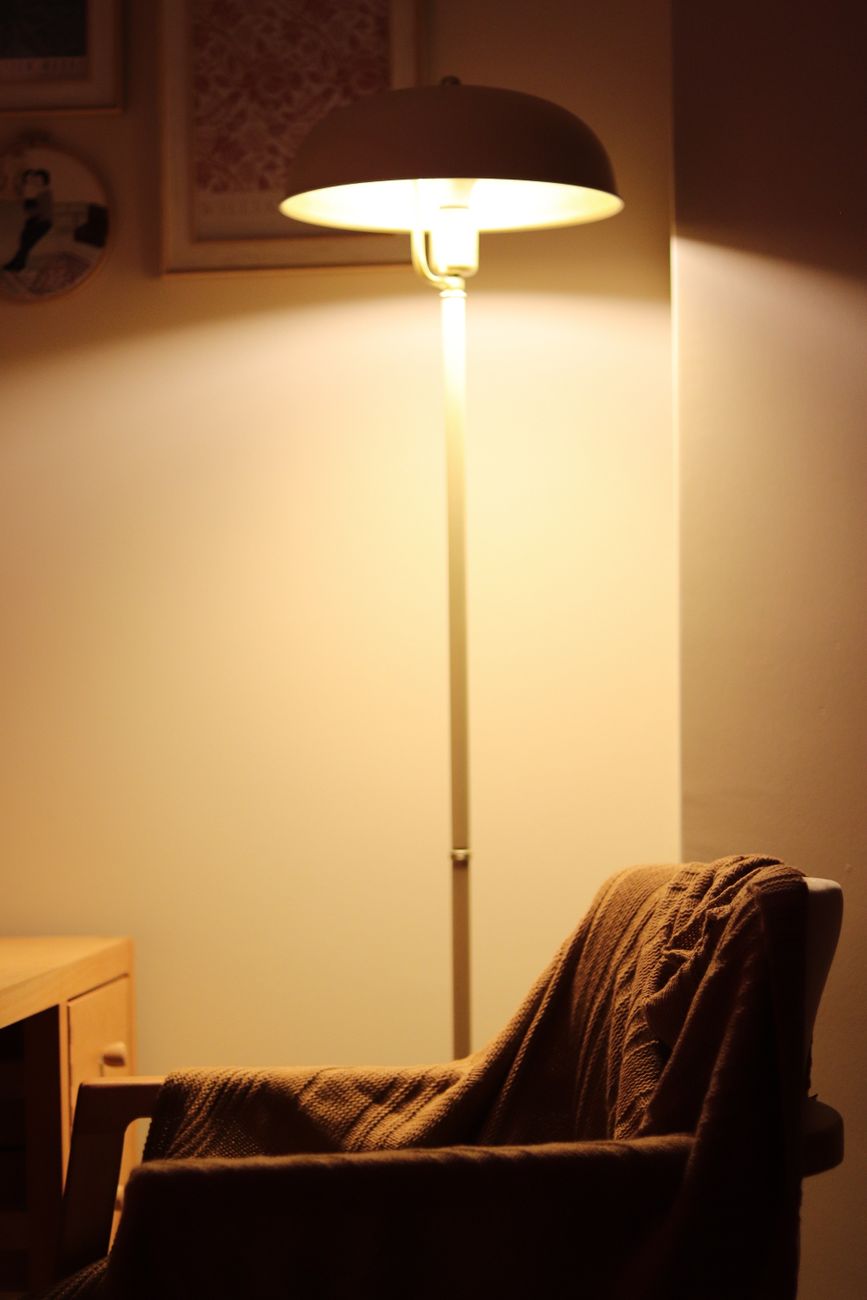
The shortest possible evening lighting routine
An evening lighting routine is the schedule on which a room’s lights step down — in brightness, in color temperature, and in number of sources — from the moment the sun sets to the moment you close your eyes. It runs in three phases. Phase 1 (sundown, roughly 6–8 p.m.): overhead off, one ambient lamp and one accent on at 60–70 percent, all bulbs at 2700K, total room output around 600–800 lumens. Phase 2 (wind-down, 8–10 p.m.): ambient drops to 40 percent, task lamp on at 100 percent only where you read or eat, accent stays, total output 350–500 lumens. Phase 3 (bedside, 10 p.m. to sleep): every source above 2200K is off, one warm 150-lumen bedside source remains, room reads at candle-light brightness. The whole protocol uses three fixtures, no smart-home stack required, and a $35 dim-to-warm bulb in the most-used lamp does 80 percent of the work.
Why light is the real timer
Most evening routines in the top search results — the 3-2-1 method, the five steps, the five B’s of bedtime — treat lighting as decoration around the parts that “matter”: tea, journaling, screen curfews, breathwork. We think the order is reversed. Light is the only external signal the body unambiguously reads as time-of-day. Tea is a habit; journaling is a habit; light at 2700K and 300 lumens at 9 p.m. is information your nervous system was built to interpret before any of those habits existed.
The practical version of this argument is that lighting is also the easiest lever to set up correctly once and then forget. A tea ritual requires nightly effort. A journal requires nightly effort. A lighting protocol — three fixtures, three switches, dimmed on a schedule you internalize over two weeks — requires the effort once and then runs itself. The room becomes the timer; you stop having to remember when to wind down because the room has already begun.
This is why we treat evening lighting as the spine of the routine rather than a footnote to it. It is the part that does the most work for the least friction, and it is the part most “evening routine” advice skips entirely. If you have already read the three-light rule, the protocol below is the scheduling layer on top of the spatial system that piece described. The rule tells you where the lamps go. The routine tells you when each one is on, and at what brightness.
The three phases, by the numbers
The three phases below are defined by what the room is for during each one — not by clock time. Adjust the start of each phase to roughly two hours before the next activity. The numbers in the table are the working targets for a 150-square-foot living room; scale up by about 20 percent per additional 50 square feet.
| Phase | Time band | Room is for | Total lumens (in room) | Color temp | Sources on | Accent role |
|---|---|---|---|---|---|---|
| Sundown | ~6–8 p.m. | Cooking, gathering, dinner | 600–800 | 2700K | Ambient + accent, dim-to-warm if available | Marks the transition from daytime |
| Wind-down | ~8–10 p.m. | Reading, conversation | 350–500 | 2400–2700K | Task at 100% + ambient at 40% + accent | Hold-over from sundown |
| Bedside | ~10 p.m. – sleep | Last 30 min before sleeping | 100–200 | 2000–2200K | One bedside source only | Becomes the only light |
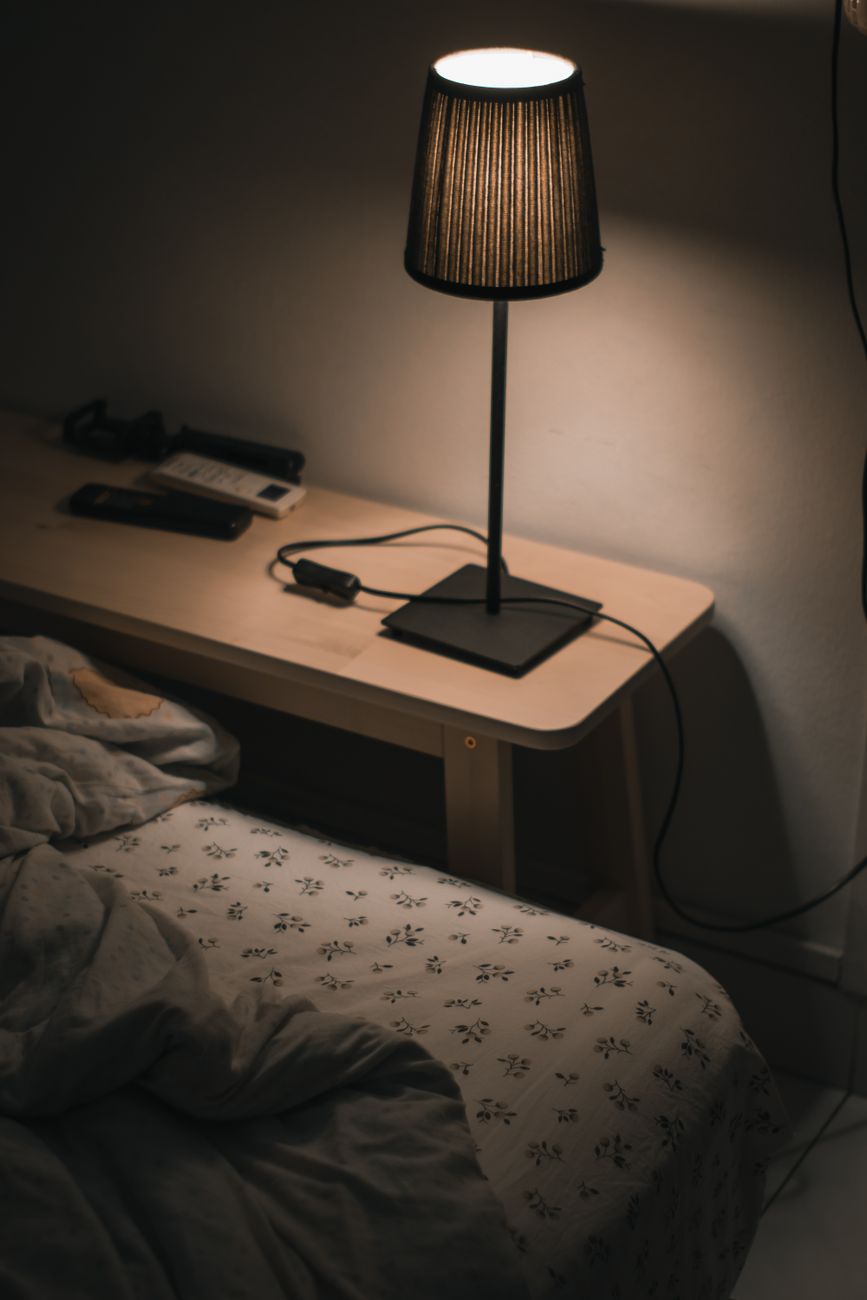
The three phases share two through-lines worth noting. First, the overhead never comes on after sundown — not at any output, not on a dimmer, not for “just a minute” to find something. If the overhead has to be on, the routine is broken; restart with the lamps. Second, every lamp in the system is on its own switch and its own dimmer. A routine that depends on remembering to walk to four different lamps to adjust them fails by the third evening. A routine that depends on flipping two wall switches and rotating one dimmer on a side table works for years.
We have seen lighting protocols that try to do this with smart bulbs on a single app schedule. They work for the first month and then drift — phones die, automations forget, the app updates and breaks. A mechanical routine with three switches outlasts every smart system we have tested through 2025. Use smart bulbs only where dim-to-warm behavior requires them (the task lamp, usually); leave the rest analog.
Three fixtures that anchor the routine
The protocol needs three working fixtures: a sundown ambient, a wind-down task lamp, and a bedside source. Each can be its own purchase or shared with the three-light rule’s living-room setup. Below are three picks across budgets, with the affiliate state flagged honestly. None of these need an electrician; all three are plug-in or table-top.
Sundown — Lamps Plus floor lamp, $280–500
The sundown anchor wants height, indirect throw, and a 600-lumen ceiling — enough to fill a 150-square-foot room without making any single point of the room feel “lit.” Lamps Plus’s mid-tier floor lamps in the $280–500 band hit the right combination of solid metal base, fabric or linen shade with a white inner liner (the part that controls glare), and a real inline dimmer. We prefer the arc-style lamps in this tier because they reach over a sofa to put light where it is needed without taking floor space against the wall.
Two specifications matter more than the rest at this tier. The shade must have a white inner liner — not metallic, not coloured — because the liner is what diffuses the bulb into the soft pool that “ambient” actually means. And the lamp must accept a standard E26 socket so you can put any dim-to-warm bulb in it; lamps with proprietary LED modules locked at one color temperature are not eligible for the routine, because the routine depends on the bulb sliding from 2700K to 2200K as the evening progresses.
Pair it with a Hue Filament or Soraa Vivid 95+ bulb at 800 lumens nominal, run at 60–70 percent during sundown.
Wind-down — IKEA TÄRNABY or similar, around $80
The wind-down phase needs one task lamp at the chair or sofa-end where the reading actually happens — bright at 600–800 lumens, on its own dimmer, with a shade that controls glare. The IKEA TÄRNABY is the working answer at the entry tier and is the same lamp we recommended in the case for one good lamp for exactly this role. The brushed-brass base is solid enough, the frosted shade kills bare-bulb glare, and the inline cord dimmer is the kind that does not hum on LED bulbs.
The upgrade path from the TÄRNABY, when the budget allows, is a $300–500 Lamps Plus exclusive in the same role — heavier base, better shade, longer cord, identical light output. The bulb does most of the work; the lamp is just what holds the bulb at the right height. Pair either lamp with a Cree TW or Soraa Vivid 95+ at 2700K and call the question closed.
Bedside — Visual Comfort plug-in sconce or table lamp, $400–800
The bedside phase deserves the heirloom tier more than any other position in the room, because it is the lamp you look at last every night for the next decade. A Visual Comfort plug-in wall sconce mounted at 48–52 inches above the floor (slightly lower than living-room sconce height, because you read it from a pillow) on a dim-to-warm bulb capable of running at 2000K becomes the only light in the bedroom for the last thirty minutes of the day. The light it produces at the lowest dim setting is closer to a candle than to electricity, which is correct.
If a wall sconce is impossible — concrete walls, a landlord with strong opinions — the same role can be played by a small Visual Comfort or Robert Abbey table lamp on the nightstand, no taller than 18 inches, with a fabric shade and a dim-to-warm bulb. Either way: one fixture, one switch within arm’s reach of the pillow, 100–200 lumens at the bulb maximum.
Setting up the routine in one weekend
Anyone can run the three-phase protocol the first night. Making it durable — running for months without thinking about it — is a separate problem. The setup work is mostly about removing decisions from the routine, not adding them. Once each switch and dimmer is in the right position, the routine becomes ambient. The list below is the install order we recommend; do it in this sequence and the routine is mechanical by the end of the second week.
- Demote the overhead. Either remove the bulb entirely for the first month, or move the overhead to a separate, less-convenient switch. The goal: the overhead should never be the easiest light to turn on after sundown. If the wall switch by the door controls it, rewire that switch to an outlet for the ambient lamp instead — about $60 and an hour with no electrician on plug-in setups.
- Position the ambient lamp. The sundown anchor goes behind the sofa or against the wall furthest from where you read. Aim the shade slightly upward; the ceiling becomes the reflector and the room fills with a soft 350-lumen wash that has no single hotspot.
- Position the task lamp. Side table at the end of the sofa, or on a small table next to the reading chair. Not the middle of the sofa, not behind it — within 18 inches of the page when seated. Inline dimmer at about thumb-height when sitting; do not put the dimmer behind the lamp where you have to feel for it.
- Wire one dim-to-warm bulb where it matters most. Most homes can get 80 percent of the routine’s benefit with a single Hue Filament or LIFX Filament bulb in the task lamp. The other two positions can stay on dimmable 95-CRI 2700K bulbs without dim-to-warm; the eye reads the task lamp as the primary, and the primary is where the warmth-slide effect is felt.
- Mount the bedside source last. A Visual Comfort plug-in sconce takes 15–25 minutes to install and a peel-and-stick cord cover. Drop the center height to about 50 inches rather than the living-room standard of 60–65.
- Practice the protocol for two weeks before adjusting. The first week always feels under-lit. The second week the eyes adjust. By the third week, an overhead-lit room reads as wrong on entry — which is the signal the routine has installed itself.
Two thirds of the routine’s effectiveness comes from getting the geometry right (where the lamps are) and one third comes from the bulbs. Do not buy the $35 dim-to-warm bulb first; buy the lamp position first. A perfectly-placed $15 lamp with a Cree TW bulb beats a misplaced $400 lamp with a Hue Filament every night.
Living with the routine
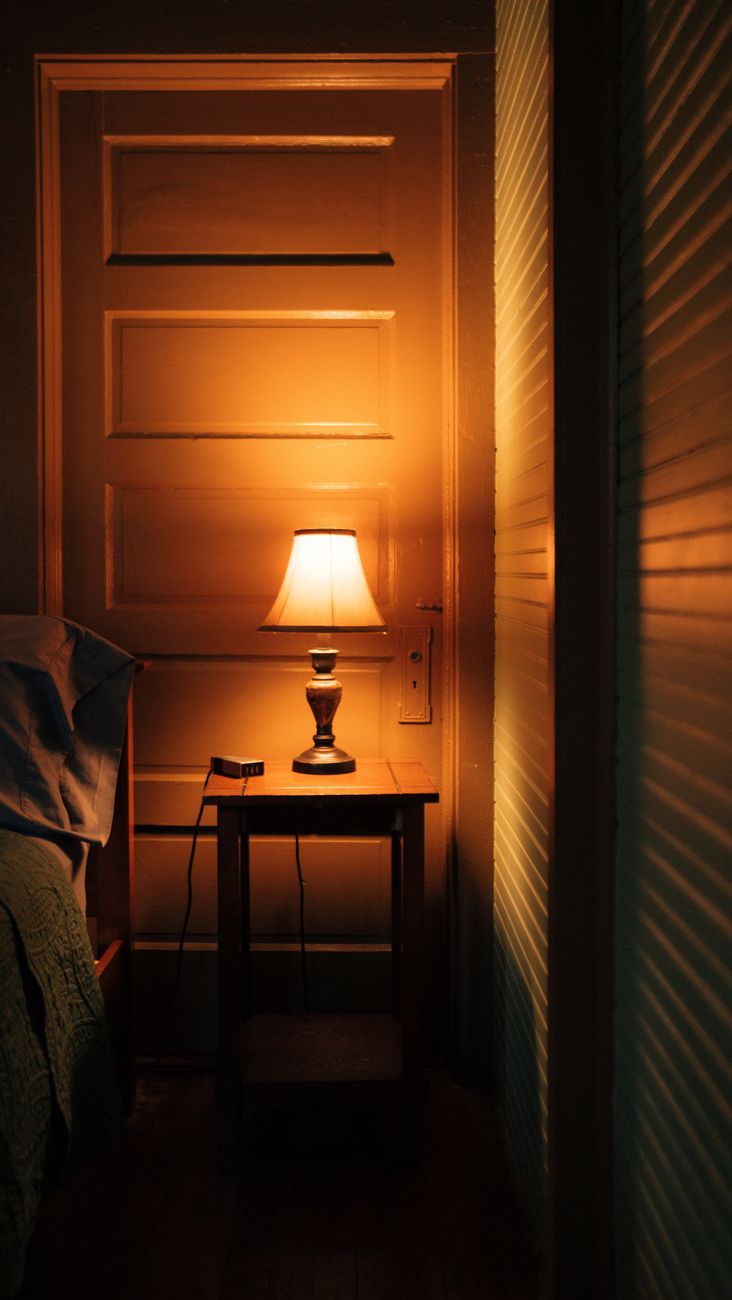
The first thing that changes is how you enter the room after sunset. You stop reaching for the wall switch by the door. The hand learns to find the dimmer on the side table within four or five evenings. By the second week, the sundown light is on before you have consciously decided to be in the room — the act of walking in and the act of turning on the lamp become one motion, the way pulling a chair out and sitting down are one motion.
The second thing that changes is the bedtime drift. Most evening routines fail because the transition from “still up” to “going to bed” is fuzzy — there is no clear external signal, so the brain keeps finding reasons to delay. The wind-down phase makes that transition visible: when the ambient lamp drops to 40 percent, the room itself says “the next thing is sleep.” Several testers report that bedtime moves earlier by 20–40 minutes within the first month, without trying — the room is telling them.
A short list of what the routine is not:
- It is not a screen curfew. Screens still produce blue light; the routine reduces the room’s contribution but does not solve a phone in the lap.
- It is not a sleep-tracking protocol. We do not measure sleep latency or recommend an app. The body knows what to do with 2200K at 150 lumens.
- It is not a wellness ritual with candles and journaling. If those help, keep them. The routine works without them, and works better than them alone if forced to pick.
If you have read the case for one good lamp, the routine is what a room with one good lamp matures into once you have three sources to compose with. The single-lamp argument was about replacing the overhead. The three-light rule was about composing the room. The routine is what those two pieces do together, on a clock.
Frequently asked questions
What is the 3-2-1 evening routine? The 3-2-1 routine is a wellness rule popularized by sleep coaches: no food three hours before bed, no liquids two hours before bed, no screens one hour before bed. It is reasonable advice and orthogonal to lighting — the lighting routine described here runs underneath it. Where they intersect is the one-hour screen rule: a room lit at 2200K and 150 lumens makes screen avoidance dramatically easier because the screen is the brightest thing in the room and the eye notices.
What is the perfect evening routine? There is no single perfect routine; there is a working one for your household. The shared elements across the routines that hold for years are: a consistent transition out of “day mode” (lighting does this best), a visible signal that bedtime is approaching (the wind-down dimming step), and one bedside source that is the same every night. Tea, journaling, and breathwork are optional add-ons. Lighting is the structural part.
What is the 5-step evening routine? Most “5-step” routines circulating online combine some version of: cleanse, hydrate, journal, stretch, sleep prep. None of them name lighting as a step. We would propose substituting: dim the overhead, set ambient to sundown level, run wind-down for 90 minutes, drop to bedside only, sleep. The five steps then map to physical actions in the room rather than a checklist of self-care tasks.
What are the 5 B’s of bedtime? The 5 B’s in most sleep-hygiene guides are: bath, brush, book, bed, breathe — a children’s sleep framework that has migrated into adult routines. Lighting does not appear in the original list but should, between book and bed: dim the lamps to bedside level before the book closes, so the eye has already adapted to 150 lumens by the time the head is on the pillow.
Should the bedroom and the living room use the same evening routine? Roughly yes, with a phase offset. The living room runs sundown and wind-down. The bedroom runs wind-down (low) and bedside only — sundown is generally not needed because the room is not in use during that phase. The shared rule across both rooms: no overhead after sunset, no source above 2700K, every source dimmable.
Does this work for early winter sunsets? Better, actually. The protocol is keyed to the body’s transition to evening, not to a clock time. In December, “sundown phase” might start at 4:30 p.m. and the routine runs longer; in June it might start at 8:30 p.m. and compress. The lighting is the same; only the duration of each phase changes. We have run the protocol through three winters and the only adjustment was a slightly longer wind-down in December and January.
Read next
- The case for one good lamp — the single-fixture starting point.
- The three-light rule — the spatial system this routine sits on top of.
- The case for plug-in wall sconces — the bedside fixture, made rental-safe.
- Affiliate and editorial disclosure — what we earn from what.