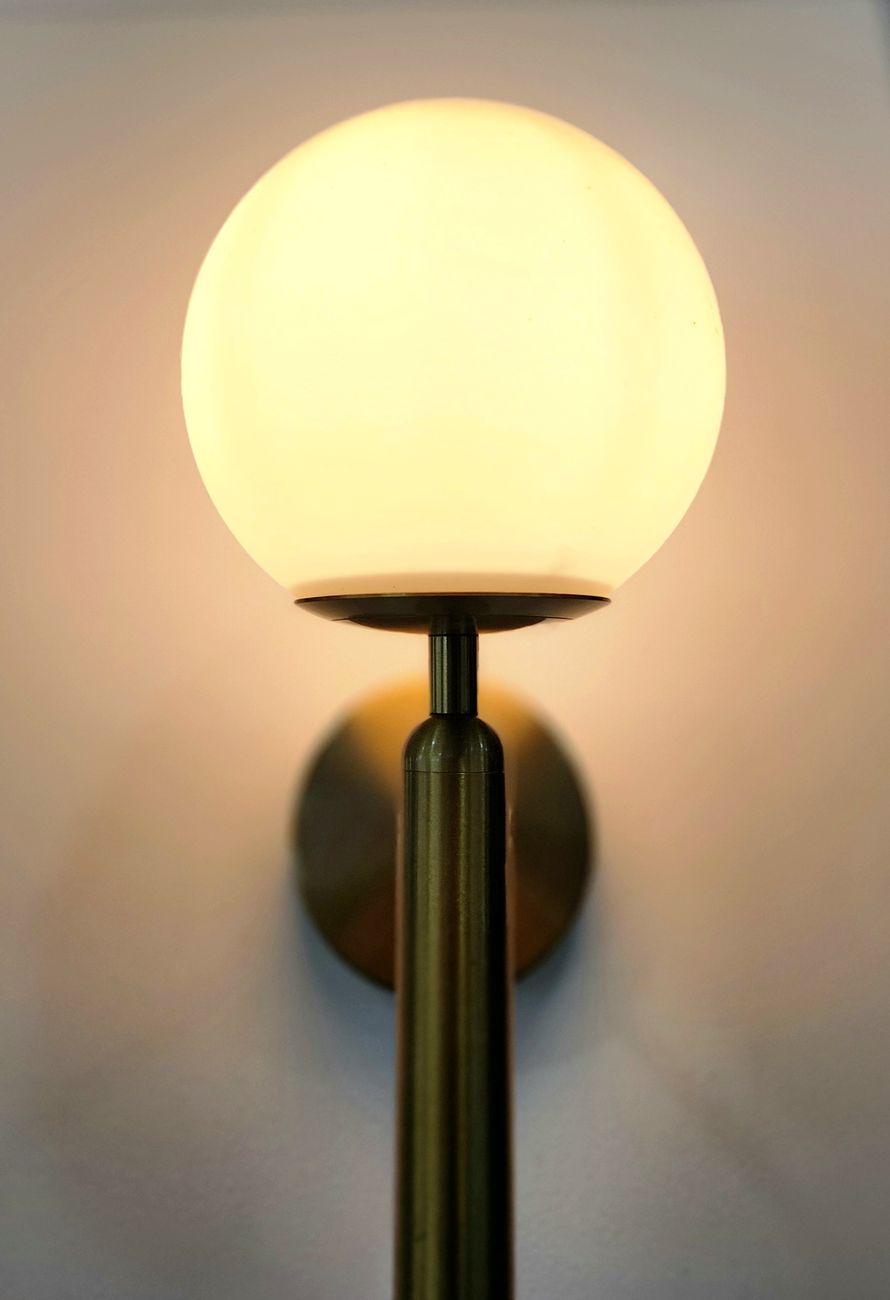
A plug-in wall sconce is the accent layer the three-light rule calls for, made available to anyone who cannot — or simply does not want to — drill into a wall. The trade is honest: you accept a cord running 36 to 48 inches down the wall in exchange for skipping the electrician, the rewiring, the landlord conversation, and the $300–500 you would otherwise spend installing a junction box. Expect to pay $60–300 for the fixture, $20 for a 2700K dim-to-warm bulb, and $15 for a peel-and-stick cord cover. The whole arrangement weighs less than a hardback book, mounts in fifteen minutes, and comes down in five when the lease ends. That is the case in one paragraph.
The longer case is that for evening lighting in a small or mid-sized room, the wall is where the accent layer wants to live. Floor lamps cannot put light at shoulder height without a footprint you may not be willing to spare. Table lamps cannot light a corner the way a wall fixture can — they light the table they sit on. A sconce occupies the wall, which is the surface a room has the most of, and which the rest of the lighting tends to neglect.
Why the wall, not the floor
The argument for using the wall over the floor is partly economic and partly geometric. Economically, plug-in sconces start around $60 — comparable to a basic floor lamp — but a wall fixture takes zero floor space, which is the resource most renters and small-apartment dwellers actually run out of. Geometrically, light placed against a wall at 60–65 inches off the floor (the standard sconce-center height) hits the eye and the ceiling at the same time, producing both a warm focal point in the room and a soft up-light wash on the ceiling. A floor lamp at the same brightness produces neither — it lights the wall behind it, which a sofa is usually blocking, and casts a pool on the rug that the sofa edge eats.
The other geometric advantage is corner activation. A 150-square-foot living room has four corners, and at least two of them are usually dark in a single-lamp setup. One wall-mounted plug-in sconce solves a corner that no floor or table lamp easily reaches: above a sideboard against the short wall, over a small framed piece on the wall behind a chair, or in the hallway joint where a coffee table cannot follow.
For the three-light rule specifically — ambient at shoulder height, task within 18 inches of where you sit, accent in a corner the eye would otherwise skip — the wall sconce is almost always the accent. It carries 150–300 lumens, which is small by any other measure, but in the third position of a layered room it is the part that makes the composition read as finished rather than functional.
What does “plug-in” actually mean?
Wall sconces come in three rental-friendly configurations, and the differences matter for both look and longevity. Picking the wrong one because the marketing copy was clear gets expensive — both in money and in disappointment when the cord routing turns out to be uglier than the fixture.
| Type | What it is | Looks like | Best for | Caveat |
|---|---|---|---|---|
| Plug-in with cord cover | Standard sconce with a 6–12 ft cord, hidden behind a peel-and-stick channel painted to match the wall | Indistinguishable from hardwired (if installed well) | Permanent rental setup, primary accent | Cord cover takes 20 min to install cleanly |
| Hardwire conversion kit | Hardwired fixture mounted on a “blank plate” that has a hidden 6 ft cord pre-attached | Same as above, slightly bulkier base | When you fall in love with a hardwire-only fixture | $20–40 extra; reduces fixture choice slightly |
| Battery / rechargeable | LED puck with magnetic base, charges via USB-C, lasts 8–14 hours per charge | Smaller, more uniform LED pucks; no cord visible | Tiny rooms, walls you cannot drill at all (concrete, brick), short-term setups | Limited brightness ceiling (~200 lumens), color rendering often 80 CRI |
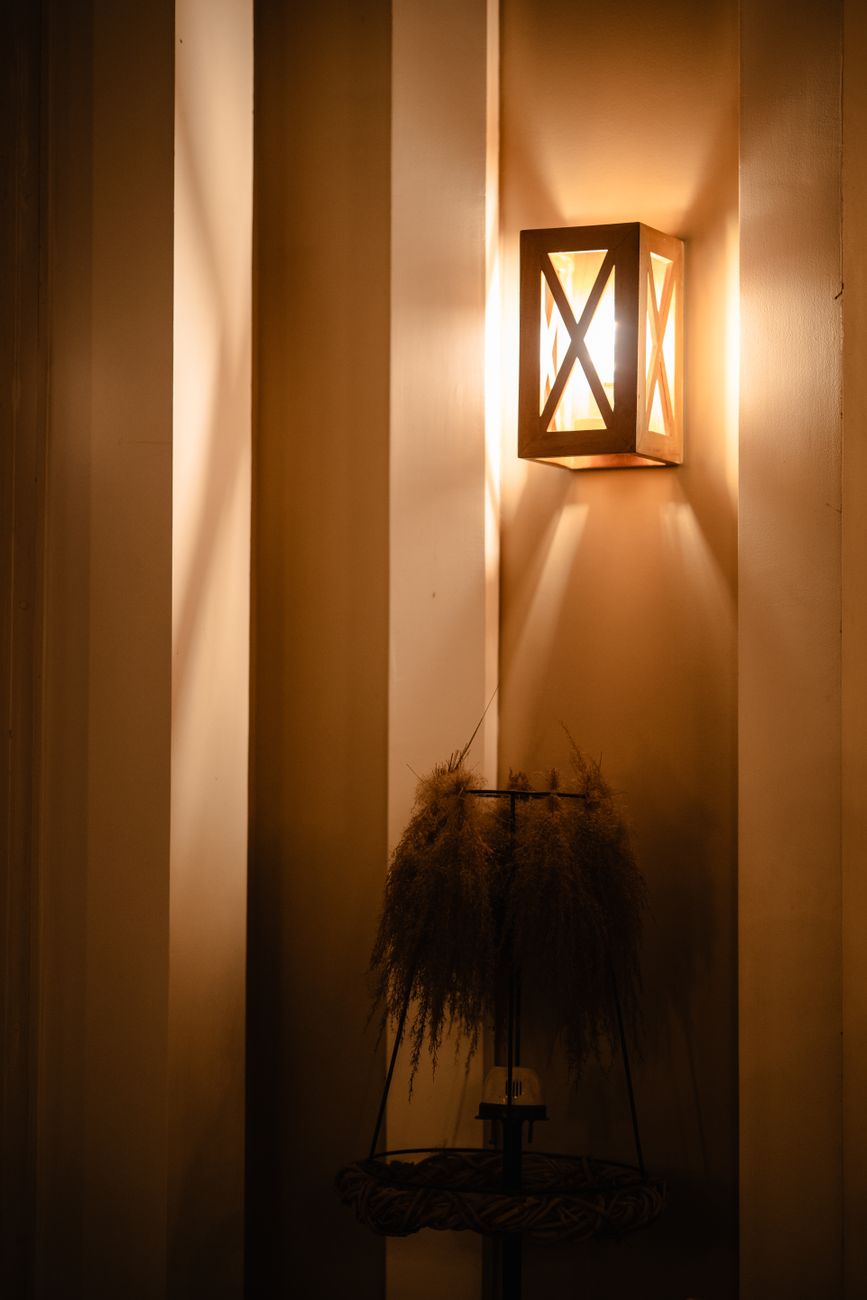
The plug-in-with-cord-cover route is the one most editorial renters land on, because the fixture itself can be from any maker — Visual Comfort, Schoolhouse, IKEA — and the cord disappearance is purely a hardware decision. The hardwire-conversion-kit route is useful when you’ve fallen for a specific hardwire fixture (most designer sconces are hardwire-only) and want to keep it through a move. Battery sconces have improved dramatically since 2023 but are still the third-best option for any space where the sconce will be on more than an hour a night.
Brightness target across all three: 150–300 lumens at the bulb, 2700K color temperature, dim-to-warm if you can. The same accent-layer math that applies to candle-and-lamp combinations applies here. The sconce is not trying to light the room. It is trying to give the eye a third point.
Three plug-in sconces we’d actually live with
Three picks across three budgets. Each is plug-in-friendly out of the box (no hardwire-conversion kit required), each accepts a standard E26 or E12 bulb you can swap into 2700K, and each survives the harder test of looking right turned off. Affiliate state on each link is flagged honestly.
Entry — IKEA SKURUP or equivalent, around $40–80
A black or brass cone-shaped wall lamp with a built-in switch, a 12-foot cord, and a wall-mount plate that takes two screws or 3M command strips depending on your level of commitment. The SKURUP is the closest thing to a no-decision purchase in the plug-in sconce category — it looks correct in almost every room, the directional shade lets you aim the light at the ceiling or the wall, and the price is low enough that you can buy two for $80–160 and bracket a sideboard.
The shortcomings are real. The plate is plastic, the bulb is exposed if you point it down, and the cord exits the back at the bottom rather than the side, which makes vertical cord covers necessary. Pair it with a 200-lumen, 2700K, 90+ CRI E26 bulb. Total cost with bulb: about $55–95. The lowest-effort accent layer money can buy.
Mid — Schoolhouse or Cedar & Moss plug-in, around $200–350
This is where most renters who care about how the room looks will land. Schoolhouse, Cedar & Moss, and a small handful of American-craft brands sell hardwire sconces with optional plug-in conversion kits that are visually indistinguishable from a permanently installed fixture — the cord exits the side of the base plate through a finished bushing, not the back, which means the cord can run along the wall rather than out the back of a fixture sitting an inch proud of the surface.
Look for: solid metal arm (not hollow stamped), real glass or fabric shade (not plastic), inline switch on the cord at a comfortable height (about 30 inches from the floor), and a UL-listed plug. Most fixtures at this tier accept dim-to-warm bulbs, which is the upgrade that makes the room actually pleasant after 9pm.
Heirloom — Visual Comfort or Robert Abbey plug-in, $400–800
The case for the heirloom tier with plug-in sconces is the same as with table lamps: a $500 fixture from Visual Comfort or Robert Abbey will be the same fixture in twenty years, with parts available, finishes you can match across rooms, and the kind of weight and assembly quality that does not feel like it is renting itself to you. Visual Comfort’s plug-in conversion option is offered on most of their wall sconce lines for a $50–80 upcharge — order the fixture with the conversion at checkout rather than rewiring later.
You are not buying these for the lighting performance, which is identical to a $150 fixture with the same bulb. You are buying them for the fixture-as-object: an arm and a shade that earn the wall they hang on. If you move every two years and the sconce comes with you, the per-year cost of a $600 sconce is $50 — less than a streaming subscription, and the only one you actually look at.
Hiding the cord, the only step that matters
A plug-in sconce that is plainly a plug-in sconce — bare cord swinging down the wall — looks like the fixture was abandoned mid-install. The cord routing is the entire difference between “rental hack” and “considered choice.” Three solutions, in order of how permanent each one feels:
- Adhesive cord raceway (the default). A 4-foot peel-and-stick plastic channel that matches the wall color, sticks straight, and houses the cord invisibly from sconce to outlet. About $12–20 per kit. Painted with the same wall paint, the result reads as a finished surface, not a hidden cord. Brands: Wiremold CordMate (white, brown, ivory), Legrand Wiremold (more finishes), generic 3M-backed channels on Amazon.
- Furniture-routed cord. If the sconce sits above a sideboard, console, or sofa back, route the cord straight down behind the furniture to the outlet hidden behind it. No raceway needed; the furniture does the hiding. Requires the fixture and outlet to be roughly aligned vertically — measure before drilling.
- Cord-channel + paint. For the most permanent look, fill the gap between cord and wall with paintable silicone caulk along the cord, then paint over. The cord disappears entirely. This is harder to undo on move-out, so weigh it against your security deposit.
Outlet height matters here too. Most apartment outlets are 12–18 inches off the floor; sconce centers want to be 60–65 inches. That makes the cord drop 42–53 inches, which is roughly one raceway kit. Buy one extra kit so you have spare channel for trimming.
Living with a sconce
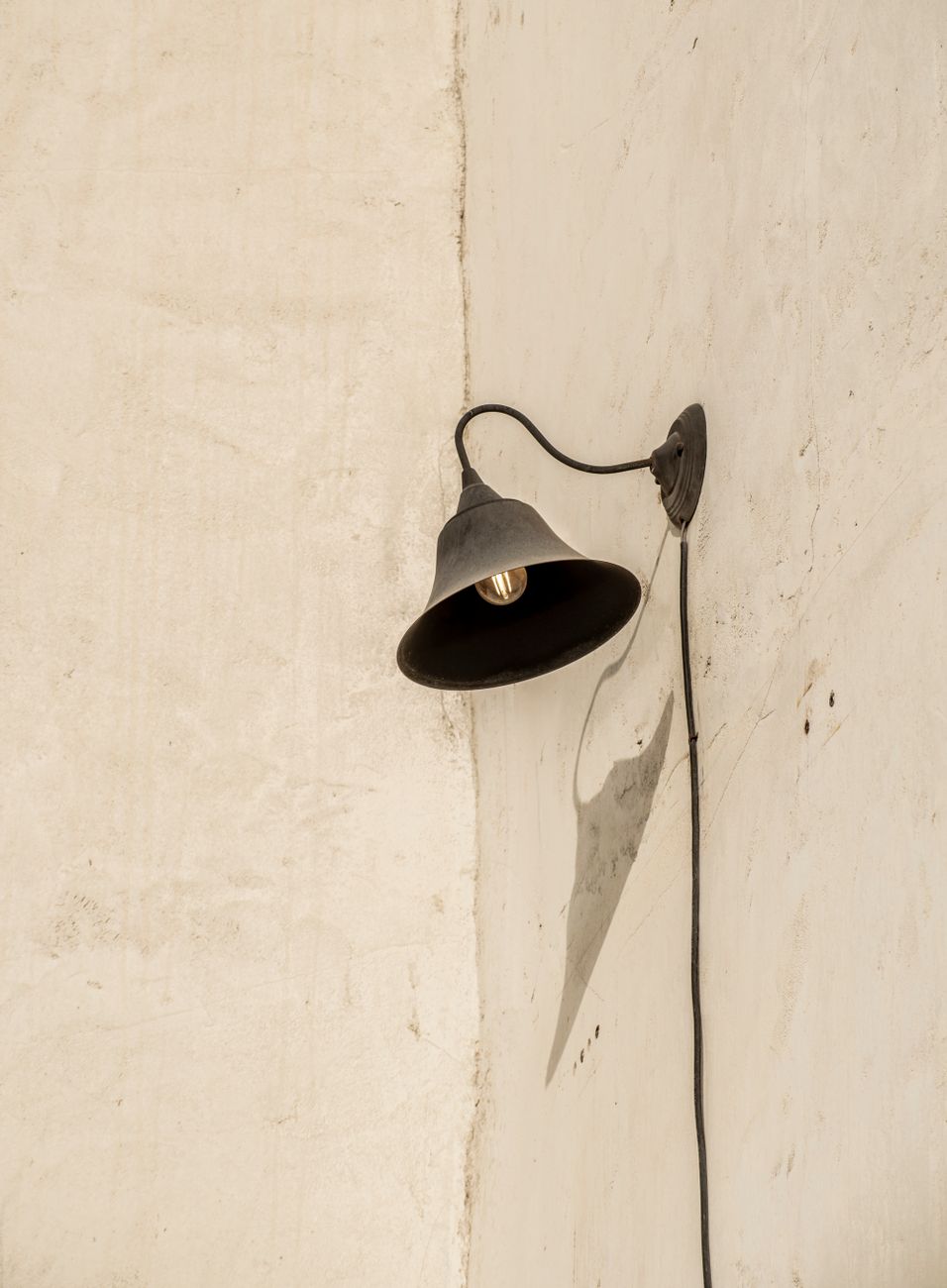
A plug-in sconce changes how you use the room more than its $150 price tag suggests it should. The accent layer in the three-light rule — the part of the system that turns “lit room” into “considered room” — depends almost entirely on whether you have a third light source at all. Most rentals have a ceiling fixture and one floor lamp. A single $80 plug-in sconce moves the room from a two-layer setup to a three-layer one. That is a larger improvement than upgrading the floor lamp from $150 to $400 would be.
The use pattern, in a typical evening, looks like this:
- Sunset. Sconce goes on first, often before any other light in the room. It marks the transition from “daytime” to “evening” and signals to anyone in the apartment that the room is being entered for use, not just walked through.
- 8–11pm. The task lamp joins the sconce during reading; the ambient lamp joins both during conversation. The sconce stays on the whole time at the same brightness, providing a constant.
- Leaving the room. The sconce is the last light to switch off — usually long after task and ambient have already gone dark. Most evenings, the sconce is the only light on for the last thirty minutes of the room being occupied.
Its job is not to be noticed, but the room is noticed because it is on. The first week you live with one, you will reach for the overhead switch and stop yourself; by the third week you will have forgotten the overhead exists.
Frequently asked questions
Do wall sconces need electricity? Hardwired sconces require a junction box in the wall and an electrician unless you already have one in place. Plug-in sconces (the subject of this piece) use a standard 110V outlet via a cord, no junction box and no rewiring required. Battery / rechargeable sconces use neither and run on internal Li-ion cells for 8–14 hours per charge. For renters, only plug-in or battery are practical; for owners willing to drill, hardwired is the cleaner long-term solution.
How high should a wall sconce be mounted? The industry standard is 60–65 inches from the floor to the center of the sconce — roughly eye level for a standing adult. For sconces flanking a piece of art or a mirror, raise the center to 1–2 inches above the eye level of the seated viewer. For a bedside sconce, drop the center to 48–52 inches so the light falls onto a pillow or open book rather than into your eyes.
Can I install a wall sconce in a rental apartment? Yes — plug-in sconces require only two small screws (or 3M Command strips for lighter fixtures) to mount the base plate, and a peel-and-stick cord cover to hide the cord to the nearest outlet. Both come down cleanly at move-out with no visible damage. Avoid hardwired fixtures unless you have written landlord permission and an electrician.
What’s the difference between a wall sconce and a wall light? The terms overlap, but “sconce” typically refers to a decorative fixture with an exposed shade or arm — designed to be seen as an object — while “wall light” is the broader category including utility-focused fixtures (under-cabinet lights, picture lights, reading lights). All sconces are wall lights; not all wall lights are sconces.
Are battery-powered wall sconces worth it? For occasional use (entryways, closets, walls where drilling is impossible) yes. For nightly evening use, no — you will resent the recharging cycle within a month, and the brightness ceiling (~200 lumens) and color rendering (~80 CRI for most models) are noticeably worse than what a $20 plug-in equivalent can do. Battery sconces have a place; the primary accent in your living room is not it.
How much does a good plug-in wall sconce cost? A respectable plug-in sconce runs $60–150 (entry tier — IKEA, Target, Amazon house brands), $200–400 (mid — Schoolhouse, Cedar & Moss, West Elm), or $500–800 (heirloom — Visual Comfort, Robert Abbey, Hudson Valley with plug-in conversion). Bulbs, cord covers, and switches add $25–40. The total $85–170 entry-level setup outperforms an unlit corner by a margin nothing else in the room comes close to.
Read next
- The three-light rule — the system this sconce fits into.
- The case for one good lamp — the starting point for any layered room.
- Affiliate and editorial disclosure — what we earn from what.